
Executive leader trusted to deliver at scale in the world’s most complex crises
I guide executive teams and boards through consequential operational, risk management, and ethics decisions when lives are on the line.
I build program delivery systems that enable organizations to operate fast and at scale without dependence on individual leaders.
Vice President, Emergencies & Humanitarian Action — International Rescue Committee
Oversight of $100M+ annual emergency portfolio across 40+ countries
Architect of global emergency preparedness, decision-making, and risk frameworks
Board member and advisor to humanitarian, data, and crisis-response organizations
Senior media spokesperson across top-tier US, UK, and European outlets
Officer of the Order of the British Empire (OBE)
After 25 years in progressively senior roles with the International Rescue Committee, I am now actively considering what is next.
How I’m relied on
I bring more than two decades of leadership in humanitarian crises where operational decisions carry immediate human, ethical, and institutional consequences. I am known to:
Make decisions under pressure
Leading when speed, access, ethics, and operational reality collide, and when the cost of delay or error is measured in lives, legitimacy, and long-term operating space.
Build systems that endure beyond individuals
Designing preparedness, response, and risk systems that allow organizations to operate at scale over time, without dependence on any single leader.
Operate with public accountability.
Representing the organization’s delivery and decisions during active crises, amid political controversy, legal constraint, and sustained media scrutiny.
How I lead in crisis
In environments where information is scant and conditions evolve faster than formal processes allow, my leadership focuses on:
Enabling timely, evidence-based decisions
Establishing clear decision thresholds and time-bound escalation so that organizations act early on the best available evidence and adjust rapidly as conditions evolve.
Protecting humanitarian access and organizational legitimacy
Maintaining speed while safeguarding ethics, access, and legal standing, so short-term action does not undermine the ability to operate over time.
Strengthening the system while responding
Using live responses to hardwire learning into preparedness, leadership, and operating systems, so each crisis leaves the organization better equipped for the next.
Leading across networks
Bringing headquarters, field leadership, donors, partners, and external stakeholders into alignment when authority is fragmented and consensus does not emerge on its own.
Professional Experience
Vice President Emergencies & Humanitarian Action
International Rescue Committee (2018 – Current)
Scaled IRC’s emergency response capability globally; rebuilt preparedness, decision-making, and risk systems; and led institutional responses to the most complex humanitarian crises of the past decade. Led IRC’s humanitarian ethics and access practice area, driving to deliver to those most in need and least served in the world’s hardest locations.
Director - Emergency Preparedness & Response
International Rescue Committee (2011 – 2018)
Designed and institutionalised IRC’s global emergency preparedness and response architecture, significantly improving speed, scale, and decision quality across rapid-onset and protracted crises.
Country Director - Afghanistan
International Rescue Committee (2009 – 2011)
Led the expansion of IRC’s Afghanistan programme through conflict and transition, scaling operations while managing access, security, and donor risk.
Country Director - Democratic Republic of Congo
International Rescue Committee (2007 – 2009)
Managed IRC’s largest country operation during active conflict, overseeing large-scale health and protection programming across multiple provinces.
Early Career - details available here
Various (1999 – 2007)
Early leadership roles across Sudan, Iraq, Kosovo, Sierra Leone, Central African Republic, Chad, Indonesia, East Timor, and Albania.
Crisis Footprint
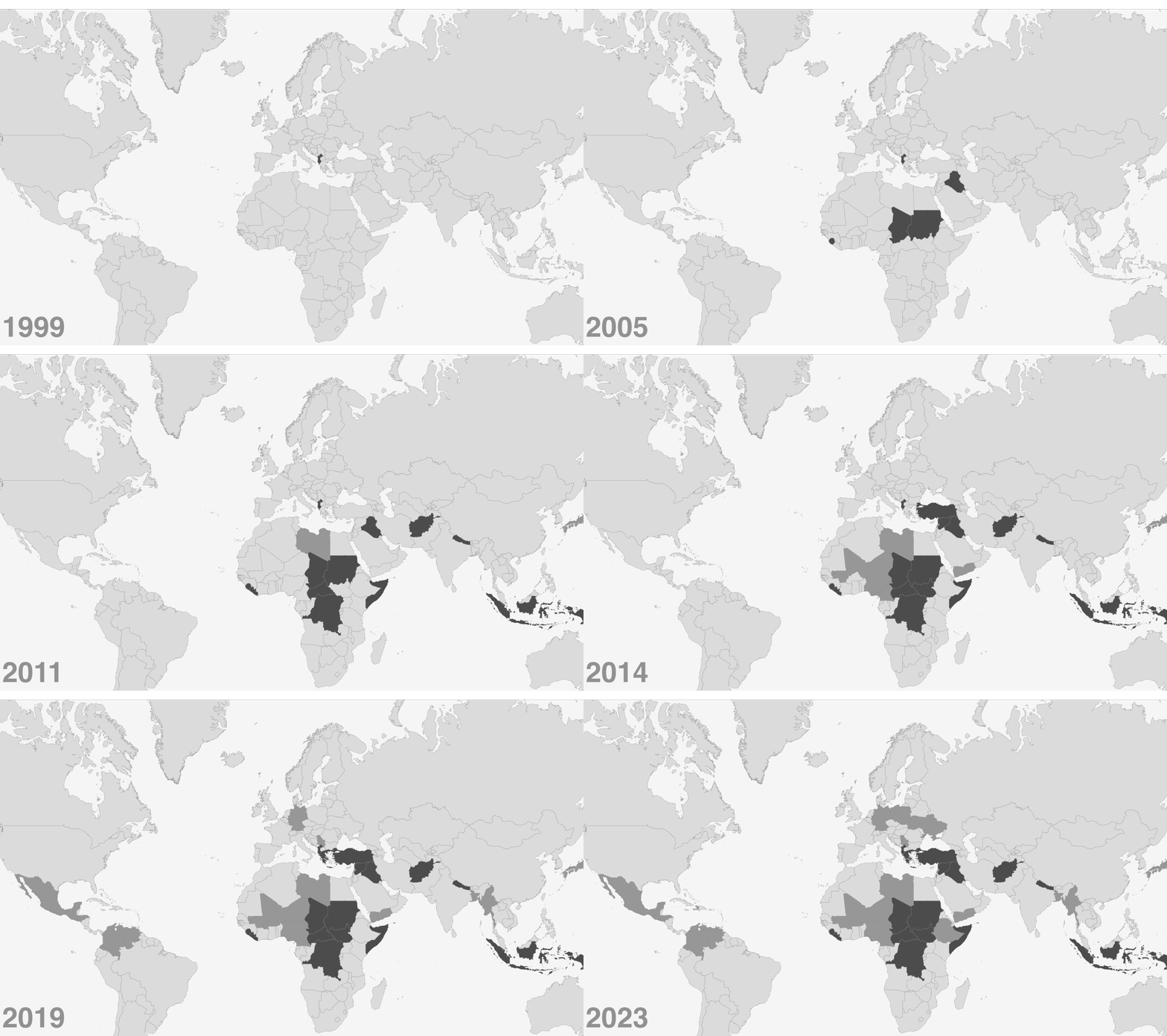
Responses led from the frontline: Albania, Kosovo, East Timor, Sierra Leone, Iraq, Sudan, Chad, Indonesia, Liberia, Nepal, DRC, Afghanistan, Somalia, South Sudan, Turkey, Syria, Greece
Responses managed from HQ: Japan, Libya, Lebanon, Mali, Yemen, Cameroon, Niger, Nigeria, Germany, Serbia, Bangladesh, El Salvador, Colombia, Venezuela, Burkina Faso, Guatemala, Honduras, Mexico, Ethiopia, Haiti, Poland, Ukraine, Occupied Palestinian Territory.
Domains of responsibility
Humanitarian emergency leadership · Organisational risk and governance · Negotiated humanitarian access · Large-scale response financing · Partnerships and localisation · Public advocacy and external representation